Best Marketing Tools for Small Business in 2026: SEO, Email, CRM and Social Compared
Updated November 27, 2026. Prices are US list prices from each company’s pricing page or recent pricing reviews, checked this month. We are not paid by any of the companies below.
Small businesses don’t need 20 marketing tools. They need one good tool for each job: getting found on Google and AI search, collecting emails, tracking customers, posting on social media and running ads. This guide groups the best marketing tools of 2026 by job, shows which have useful free plans, and explains what changed this year, from Adobe buying Semrush to Mailchimp shrinking its free plan.
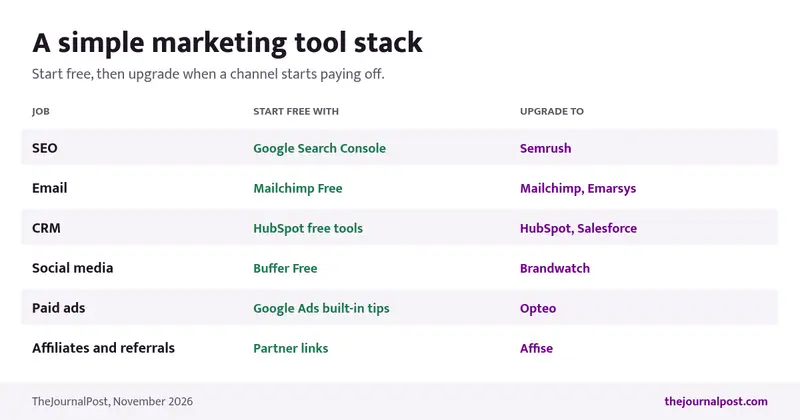
Quick answer: Start with free tools: Google Search Console and GA4 for SEO and analytics, HubSpot’s free CRM for customers, Buffer for scheduling social posts and Mailchimp or another free email plan for newsletters. Upgrade to Semrush when SEO becomes a main sales channel, and add Opteo once you spend real money on Google Ads.
Table of Contents
What changed in marketing tools in 2026
- Adobe now owns Semrush. Adobe completed its $1.87 billion purchase of Semrush on April 28, 2026, and is folding it into its customer experience tools. Semrush still sells its own plans.
- SEO tools added AI search tracking. Semrush One combines classic SEO tools with tracking of how your brand appears in AI answers, starting at $199 a month.
- Mailchimp’s free plan shrank again. In early 2026 Mailchimp cut its free plan from 500 contacts and 1,000 sends to 250 contacts and 500 sends a month, and unsubscribed contacts still count toward the limit.
- Falcon.io is now Brandwatch. The Falcon.io social media suite has been folded into Brandwatch’s Social Media Management product.
A simple marketing tool stack
What marketing tools cost
| Tool | Job | Free plan? | Paid from (monthly) |
|---|---|---|---|
| Semrush | SEO and AI visibility | Limited free account | $139.95 (Pro) |
| Google Search Console + GA4 | SEO data and analytics | Yes, fully free | Free |
| Mailchimp | Email marketing | 250 contacts, 500 sends | About $13 (Essentials) |
| HubSpot | CRM and marketing | Yes, up to 2 users | $20 per seat (Starter; promos lower) |
| Salesforce | CRM for growing teams | Free trial only | Per user, varies by edition |
| Buffer | Social media scheduling | 3 channels | $6 per channel (Essentials) |
| Brandwatch | Social listening and management | No | Custom quote |
| Opteo | Google Ads optimisation | Free trial | Varies by ad spend |
| Affise | Affiliate and partner tracking | No | Custom quote |
SEO tools
Semrush: best all-in-one SEO and AI visibility tool
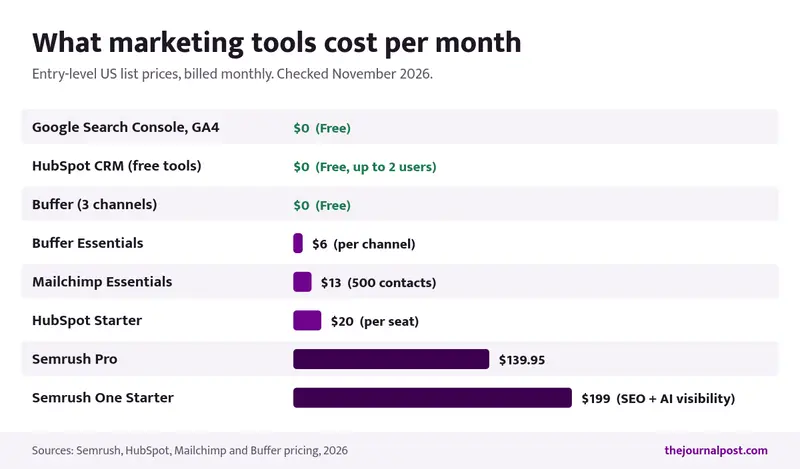
Semrush covers keyword research, rank tracking, site audits, backlink analysis and competitor research. Its Pro plan costs $139.95 a month, Guru $249.95 and Business $499.95, with about 17% off for yearly billing; extra users cost from $45 a month. Semrush One adds tracking of your brand in AI answers from $199 a month. Since April 2026 it is owned by Adobe.
Google Search Console and GA4: best free starting point
Google Search Console shows which searches bring people to your site, which pages are indexed and what errors Google finds. Google Analytics 4 (GA4) shows what visitors do once they arrive. Both are free and should be set up before you pay for anything else.
Email marketing
Mailchimp: best known, but the free plan is small
Mailchimp is easy to use and connects to almost everything. Its free plan now covers only 250 contacts and 500 emails a month, and Essentials starts at about $13 a month for 500 contacts. Remember that unsubscribed contacts count toward your plan until you archive them.
Emarsys: for larger ecommerce brands
Emarsys, now SAP Emarsys, is an enterprise platform for personalised email, SMS and app messages, mostly used by large retailers. It is sold by custom quote and is more than most small businesses need.
Gamooga and other automation tools
Smaller marketing automation platforms such as Gamooga target specific regions or industries. Check that a tool is still actively supported before signing a long contract.
CRM
HubSpot: best free CRM
HubSpot’s free tools include a CRM, forms, email tracking and live chat for up to two users. Paid Starter plans list at about $20 per seat a month, with frequent promotional discounts, and bundle marketing, sales and service features. The jump to Professional is large, so stay on Starter until you need advanced automation.
Salesforce: best for growing sales teams
Salesforce is the most powerful CRM and now builds AI agents (Agentforce) into its platform. It is priced per user and is best for companies with a dedicated sales team and someone to manage the setup.
Social media management
Buffer: best for small teams
Buffer charges per social channel. The free plan covers three channels with 10 scheduled posts each; Essentials costs $6 per channel a month ($5 if paid yearly) and Team costs $12 per channel with unlimited users.
Brandwatch (formerly Falcon.io): for brands that need listening
Brandwatch combines social publishing, inbox, analytics and social listening. Falcon.io’s tools now live inside Brandwatch’s Social Media Management product. It is aimed at larger teams and sold by quote.
Social listening tools like Synthesio
Synthesio, now owned by research firm Ipsos, tracks brand mentions across social media and news. Tools like this suit brands that need market research, not small local businesses.
Paid ads
Google Ads: the main paid search platform
Google Ads lets you show ads in Google Search, YouTube and partner sites. It is free to open an account; you pay for clicks. Use its built-in recommendations carefully, since some increase spend more than results.
Opteo: best Google Ads helper
Opteo scans your Google Ads account and suggests specific improvements, such as negative keywords and bid changes. It saves time for agencies and businesses managing several accounts.
Affiliates, referrals and attribution
Affise: affiliate and partner tracking
Affise tracks clicks, conversions and payouts for affiliate and partner programmes. It suits businesses that pay many partners or networks.
Referral and attribution tools
Referral tools such as RewardStream help customers refer friends for rewards, and attribution tools such as LeadsRx try to show which channels led to a sale. Before paying, check whether your CRM, ecommerce platform or GA4 already covers what you need.
Which marketing tool should you start with?
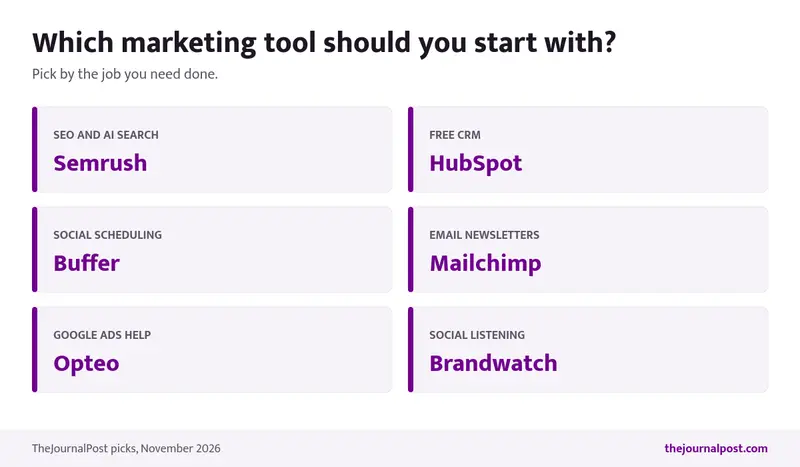
- Getting found on Google and AI search: Search Console first, then Semrush
- Keeping track of customers: HubSpot’s free CRM
- Posting on social media: Buffer
- Sending newsletters: Mailchimp for small lists; compare alternatives if your list grows
- Running Google Ads: Google Ads plus Opteo once spend grows
- Monitoring your brand online: Brandwatch for larger brands
Tips for choosing marketing tools
- Start with one channel. Pick the channel that already brings customers and buy tools for that first.
- Watch per-seat and per-contact pricing. Costs grow with users, contacts or channels, not just the headline price.
- Pay yearly only after a trial. Yearly plans save 15 to 20% but lock you in.
- Check the vendor is still active. Many tools reviewed in older articles have been bought, renamed or closed.
- Own your data. Export contacts and reports regularly so you can switch tools without losing history.
Frequently asked questions
Google Search Console and GA4 for SEO and analytics, HubSpot’s free CRM for up to two users, Buffer’s free plan for up to three social channels, and Mailchimp’s free plan for very small email lists are the best free starting points in 2026.
Semrush Pro costs $139.95 a month, Guru $249.95 and Business $499.95, with about 17% off for yearly billing. Semrush One plans with AI visibility tracking start at $199 a month.
Adobe completed its acquisition of Semrush on April 28, 2026 for about $1.87 billion.
Yes, but the free plan now covers only 250 contacts and 500 email sends a month after cuts in early 2026.
Yes. HubSpot’s free tools include a CRM for up to two users. Paid Starter plans list at about $20 per seat a month, often with promotional discounts.
Falcon.io became part of Brandwatch, and its publishing, engagement and analytics tools are now sold as Brandwatch Social Media Management.
Buffer’s free plan covers three channels. Essentials costs $6 per channel a month ($5 billed yearly), and Team costs $12 per channel a month with unlimited users.
Sources
- Adobe press release and Form 10-Q on the Semrush acquisition (2026)
- Semrush pricing coverage (Capterra, SEO.com, 2026)
- Mailchimp free plan changes (TechRadar, EmailOctopus, Benchmark Email, 2026)
- HubSpot pricing pages and 2026 pricing reviews
- Buffer pricing page and FAQ (2026)
- Brandwatch notice on Falcon.io
Prices change often. Always confirm on the official site before you subscribe.


3 Comments