
Best Free Email Providers in 2026: 10 Services Compared (Storage, Privacy, Price)
Updated November 23, 2026. Storage limits and prices below were checked against each provider’s own help and pricing pages this month.
Free email got less generous in 2025 and 2026. Yahoo cut its famous 1 TB of free storage, and Google started giving some new accounts less space unless they add a phone number. So the old “just use whatever you signed up with” advice no longer works for everyone. Below we compare the 10 email providers people ask about most, including the free ones and the paid privacy options, so you can pick the right one in a few minutes.
Quick answer: For most people, Gmail is still the best free email thanks to its spam filtering and apps, with up to 15 GB of storage shared with Google Drive and Photos. Choose Outlook.com if you live in Windows and Office, GMX if you want the most free storage (65 GB), Proton Mail or Tuta for privacy and encryption, and Zoho Mail if you want free email on your own domain.
Table of Contents
What changed for free email in 2025 and 2026
- Yahoo Mail cut free storage from 1 TB to 20 GB on August 27, 2025, and Yahoo Mail Plus dropped from 5 TB to 200 GB. Users in the UK and EU get 15 GB. In November 2026, some users also reported notices of a further cut to 3 GB; Yahoo’s own help page still lists 20 GB, so watch your inbox for an official notice.
- Gmail’s 15 GB is now “up to” 15 GB. Since May 2026, Google has tested giving some new accounts only 5 GB until a phone number is added. Existing accounts are not affected.
- Outlook.com still gives 15 GB of mailbox storage, kept separate from 5 GB of OneDrive cloud storage.
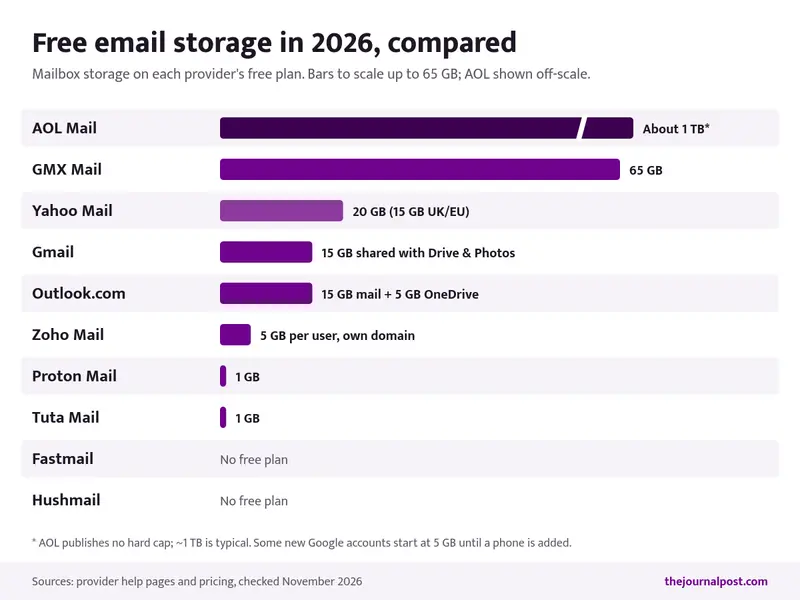
- AOL and GMX are now the storage leaders among free providers.
Best email providers in 2026 at a glance
| Provider | Free storage | Paid plan from | Best for |
|---|---|---|---|
| Gmail | Up to 15 GB (shared) | Google One 100 GB, $19.99/year | Most people |
| Outlook.com | 15 GB mail + 5 GB cloud | Microsoft 365 Basic, 100 GB mailbox | Windows and Office users |
| Yahoo Mail | 20 GB (15 GB UK/EU) | 100 GB for $1.99/month | Existing Yahoo users |
| AOL Mail | About 1 TB (no published hard cap) | Free (ad-supported) | Maximum storage, simple inbox |
| GMX Mail | 65 GB, 50 MB attachments | Free (ad-supported) | Large storage and attachments |
| Zoho Mail | 5 GB per user, up to 5 users | Mail Lite, $1/user/month | Free email on your own domain |
| Proton Mail | 1 GB | Mail Plus, from EUR 3.99/month | Privacy and encryption |
| Tuta Mail | 1 GB | Revolutionary, EUR 3/month (yearly) | Cheapest encrypted email |
| Fastmail | No free plan (30-day trial) | Individual, $6/month | Fast, ad-free power users |
| Hushmail | No free plan | Personal, $59.99/year | Encrypted mail and secure forms |
The 10 email providers compared
1. Gmail: best free email for most people
Gmail remains the default for good reason: excellent spam filtering, fast search, and tight links with Android, Google Drive, Calendar, Meet and Google’s AI tools. Every standard Google account includes up to 15 GB, but that space is shared between Gmail, Drive and Google Photos, so a big photo library eats into your email space. Some new accounts now start at 5 GB until you verify a phone number. If you run out, Google One plans start at 100 GB for $19.99 a year.
- Good: spam filtering, search, apps on every device, huge ecosystem
- Watch out: shared storage, ads in the free version, less private than encrypted providers
2. Outlook.com: best for Windows and Microsoft Office
Microsoft’s free email (formerly Hotmail) gives you 15 GB of mailbox storage, kept separate from 5 GB of OneDrive cloud storage, plus calendar, contacts and web versions of Word, Excel and PowerPoint. The free version shows ads. Microsoft 365 Basic removes ads and raises your mailbox to 100 GB, which is also the cap for consumer mailboxes on every personal plan.
- Good: separate mail storage, Office integration, strong calendar
- Watch out: ads on free accounts, mailbox maxes out at 100 GB even when paid
3. Yahoo Mail: fine for existing users, no longer a storage pick
Yahoo used to be the storage champion with 1 TB free. Since August 2025 the free limit is 20 GB in most regions and 15 GB in the UK and EU, and accounts that go over the limit stop sending and receiving mail until you delete messages or upgrade. Paid options are a 100 GB plan at $1.99 a month, Yahoo Mail Plus with 200 GB and no ads, and a 1 TB plan. If you have a long-running Yahoo inbox, check your storage now.
- Good: familiar interface, disposable addresses, works with other accounts
- Watch out: big storage cuts with more reportedly coming, ads in the free version
4. AOL Mail: most free storage, basic features
AOL Mail is still free and still very roomy. AOL describes its storage as unlimited, though new accounts typically come with a cap of about 1 TB. Attachments are limited to 25 MB, the interface is simple, and accounts left unused for a long time can be closed. It suits people who want a no-fuss inbox with lots of room, but it is light on modern features.
- Good: the most free storage, simple to use
- Watch out: dated features, ads, owned by the same company as Yahoo, so policies could change
5. GMX Mail: 65 GB free and 50 MB attachments
GMX is the best-kept secret on this list. Free accounts get up to 65 GB of email storage and can send attachments up to 50 MB, double the usual 25 MB, plus 2 GB of free cloud storage and alias addresses. It is ad-supported and less polished than Gmail, but for storage-hungry users it is the strongest free option with clear published limits.
- Good: 65 GB storage, 50 MB attachments, aliases
- Watch out: ads, fewer integrations, less refined mobile app
6. Zoho Mail: free email on your own domain
Zoho Mail’s Forever Free plan is the rare free service that lets you use your own domain, such as you@yourbusiness.com. It covers up to 5 users with 5 GB each and 25 MB attachments. The catch: the free plan is webmail and Zoho’s own apps only, without IMAP, POP or ActiveSync, so you cannot use it in Outlook or Apple Mail. Paid Mail Lite starts at $1 per user per month.
- Good: custom domain for free, no ads, good for small teams
- Watch out: no IMAP/POP on free, a sixth user means paying for everyone
7. Proton Mail: best for privacy
Swiss-based Proton Mail encrypts your mailbox end to end, shows no ads and is funded by paid plans. The free plan gives 1 GB of mail storage (500 MB at first, rising to 1 GB once you complete the starter steps) and a 150-message daily send limit. Mail Plus costs EUR 4.99 a month or EUR 3.99 a month on a yearly plan and adds 15 GB, 10 addresses and a custom domain.
- Good: end-to-end encryption, no ads, extra apps like VPN and Drive
- Watch out: small free storage, daily send limit on free
8. Tuta Mail (formerly Tutanota): cheapest encrypted email
German provider Tuta encrypts email, contacts and calendars, including subject lines, and offers a free plan with 1 GB, one calendar and 3 labels. The Revolutionary plan is EUR 3 a month on yearly billing with 20 GB and custom domains, and Legend is EUR 8 a month with 500 GB. Tuta renamed itself from Tutanota in 2023, so older guides may use the old name.
- Good: strong encryption, low paid prices, open source
- Watch out: no IMAP support for desktop apps, small free plan
9. Fastmail: best paid email without ads
Fastmail has no free plan, only a 30-day trial, but it is fast, clean and ad-free, with 50 GB of storage, custom domains, hundreds of aliases, calendars and full support for third-party email apps. The Individual plan is $6 a month or $5 a month billed yearly. It does not offer built-in end-to-end encryption, so privacy-first users should still look at Proton or Tuta.
- Good: speed, aliases, works with any email app
- Watch out: paid only, no end-to-end encryption
10. Hushmail: encrypted email with secure forms
Hushmail is aimed mostly at businesses, especially healthcare and legal teams, but it has a personal plan at $59.99 a year with OpenPGP encryption and no ads. The personal plan uses Hushmail’s own domains; using your own domain requires a business plan. Healthcare plans start at $11.99 a month.
- Good: encryption plus secure forms and signatures
- Watch out: no free plan, limited apps for personal users
Which email provider should you choose?
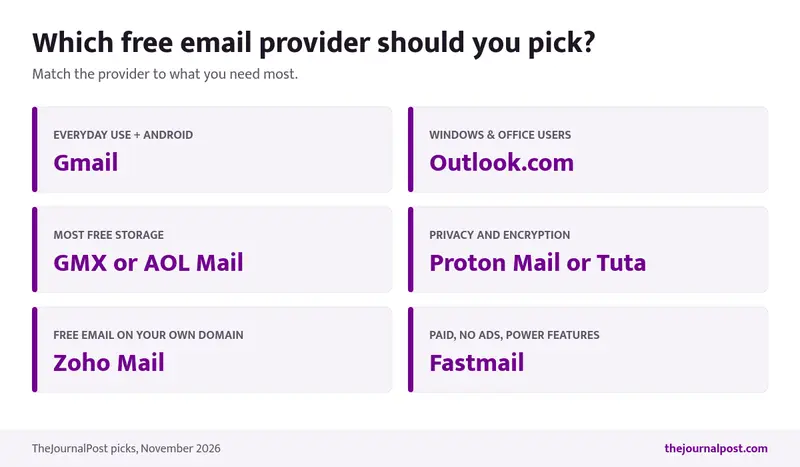
- You want one account that does everything: Gmail.
- You use Windows, Office or Teams: Outlook.com.
- You never want to delete email: GMX or AOL Mail.
- Privacy matters most: Proton Mail, or Tuta if you want the cheapest paid upgrade.
- You need a professional address on your domain for free: Zoho Mail.
- You are happy to pay for speed and no ads: Fastmail.
How we compared these providers
We compared free and entry-level paid plans using each provider’s official pricing and help pages, checked in November 2026, and cross-checked recent changes against news coverage. We looked at free storage, attachment limits, paid upgrade prices, privacy and encryption, custom domain support and how each one works with other apps. Prices are in the currency each provider publishes and may vary by country.
Tips before you switch email providers
- Turn on two-factor authentication on any account you keep.
- Use the provider’s import tool (Gmail, Outlook and Proton all have one) to bring old mail and contacts across.
- Set up forwarding from your old address for a few months so nothing is missed.
- Check storage on old Yahoo and Gmail accounts so mail does not start bouncing.
- Keep your old account active by logging in occasionally; inactive free accounts can be deleted.
Frequently asked questions
Gmail is the best all-round free email for most people because of its spam filtering, search and apps. GMX offers the most clearly published free storage (65 GB), Proton Mail is best for privacy, and Zoho Mail is best if you want free email on your own domain.
AOL Mail offers the most, with about 1 TB typical for new accounts, followed by GMX with 65 GB. Yahoo now gives 20 GB (15 GB in the UK and EU), and Gmail and Outlook.com give 15 GB each.
Yes. Yahoo reduced free storage from 1 TB to 20 GB on August 27, 2025, and to 15 GB for users in the UK and EU. In November 2026 some users reported notices of a further cut to 3 GB, which Yahoo had not confirmed on its help page.
Existing Gmail accounts keep up to 15 GB, shared with Google Drive and Photos. Since May 2026, Google has tested giving some new accounts 5 GB until a phone number is added.
Proton Mail and Tuta are the most secure free options, since both use end-to-end encryption and do not show ads. Their free plans include 1 GB of storage.
Yes. Zoho Mail’s Forever Free plan supports one custom domain for up to 5 users with 5 GB each, though it works only in Zoho’s webmail and apps, not in Outlook or Apple Mail.
Sources
- Yahoo Help, Yahoo Mail Storage FAQ
- Microsoft Support, Storage limits in Outlook.com
- Google One and Google Account storage policy coverage (Android Authority, May 2026)
- Zoho Mail pricing page
- Proton plans explained (Proton Support)
- Tuta pricing page
- Fastmail pricing page
- GMX Mail storage and attachment pages
- Hushmail plans and pricing
- Lowyat.NET on reported Yahoo Mail 3 GB notices (November 18, 2026)
Prices and limits change often. Always confirm on the provider’s official site before you sign up or pay.




2 Comments